Describe the job it needs to do
A practical part has more to tell us than its outline. Explain where it sits, what it connects to and whether it will move, carry a load or be exposed to heat or weather. Include photographs or a sketch of the arrangement where useful, without sending confidential files before their handling is agreed.
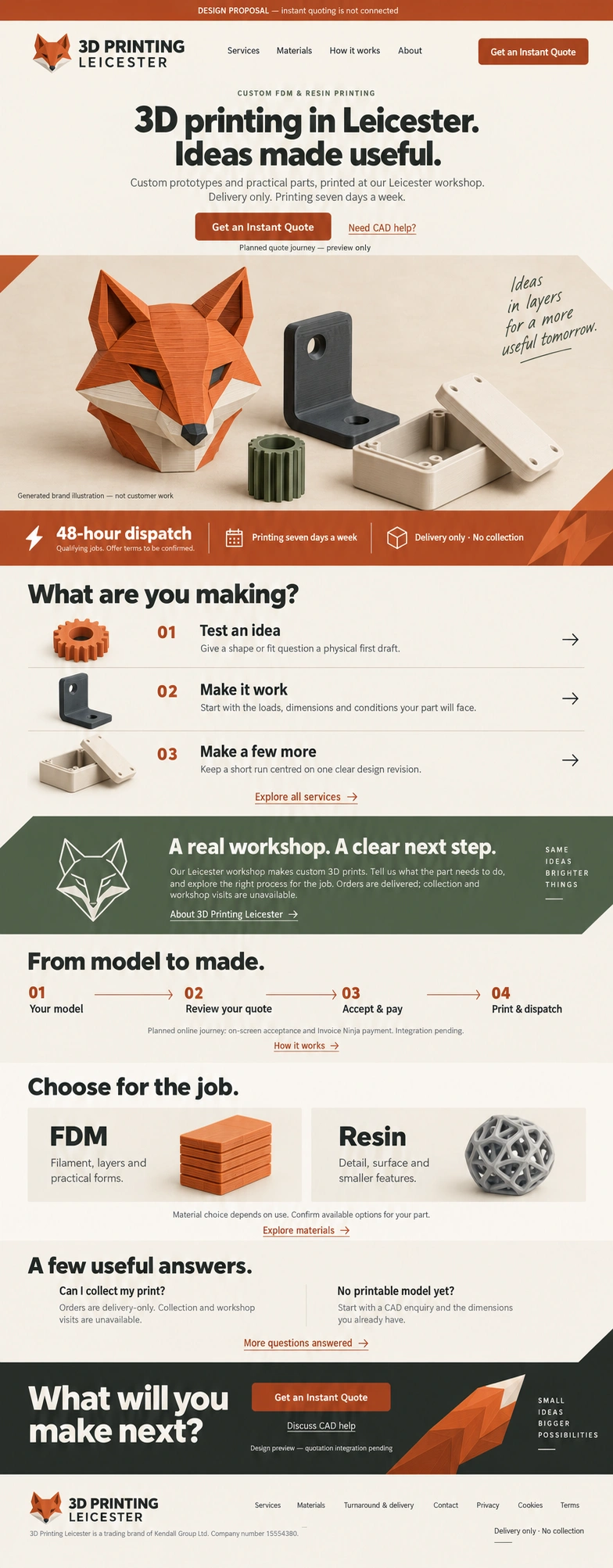
An enclosure, spacer or bracket can be a useful way to discuss a shape. The illustrations on this site are examples of forms, not certified or tested designs for sale.
Which features matter most?
Identify mating surfaces, holes, clearances and any feature that determines whether the part can be used. Describe the dimensions you need rather than assuming that printer resolution is the same as guaranteed finished accuracy. Tolerance commitments need an agreed specification.
Material is only one part of the decision
The exact grade, geometry, orientation and processing conditions all matter. A family name such as PETG or resin does not establish that a finished part is suitable for your application. Read the materials guide and explain the operating conditions with your enquiry.
No safety-critical, medical, food-contact or other regulated suitability is claimed here. Requirements outside ordinary illustrative or practical work need specific assessment; do not infer certification from a process or material name.
If the model needs a change, CAD modelling can be scoped separately. For repeated quantities, keep the agreed version consistent with the batch brief.